
Does matcha keep you awake? Caffeine, timing and tips
A cup of matcha contains 60 to 70 mg of caffeine, which stays active for several hours. Here is when to stop and how to enjoy it without ruining your nights.
Yes, matcha can keep you awake if you drink it too late, because a 2 g cup contains about 60 to 70 mg of caffeine, roughly the same as an espresso. Its L-theanine gives a calmer kind of energy, but it does not cancel out the caffeine. If you are sensitive, the simplest rule is to have your last matcha in the early afternoon.
How long does caffeine stay in your body?
Caffeine is cleared gradually. Scientists talk about its half-life: the time it takes your body to get rid of half of it. In adults it is measured in several hours, and it varies widely from one person to another depending on genetics, age, pregnancy, some medications or smoking. In practice, part of the caffeine from a matcha at 5 pm may still be around at bedtime.
That is why two people can react so differently: one has a latte at 6 pm and falls asleep easily, while the other lies awake after a matcha at 4 pm. The only reliable rule is to watch how your own body responds.
What about L-theanine?
Matcha stands out from coffee thanks to L-theanine, an amino acid found naturally in tea leaves. Combined with caffeine, it gives an energy often described as calmer and steadier, without the jittery spike some people get from coffee. Many matcha drinkers say they feel focused rather than wired.
But beware of shortcuts: L-theanine does not turn matcha into an evening drink. The caffeine is still there, and it can delay sleep or make it lighter even if you do not feel buzzy. For a closer comparison, read our article matcha or coffee.
What time should you stop drinking matcha?
There is no universal cut-off, but here are practical guidelines:
- Caffeine-sensitive people: last cup in the early afternoon, around 1 or 2 pm.
- Average tolerance: avoid matcha for roughly six hours before bed.
- Seasoned drinkers: some handle a late-afternoon cup, but keep an eye on the quality of your sleep, not just how quickly you nod off.
If you go to bed late, as many people do in Moroccan summers or during Ramadan, shift these times accordingly. What matters is counting back from your actual bedtime.
Quantity matters as much as timing
A 2 g cup does not have the same effect as a large 4 g latte, which can approach 120 mg of caffeine. You also need to add up the rest of your day: morning coffee, glasses of mint tea (about 20 to 40 mg each depending on the brew), soft drinks, chocolate. For a healthy adult, EFSA uses up to 400 mg of caffeine per day as a reference, but a much smaller amount taken late can be enough to disturb sleep.
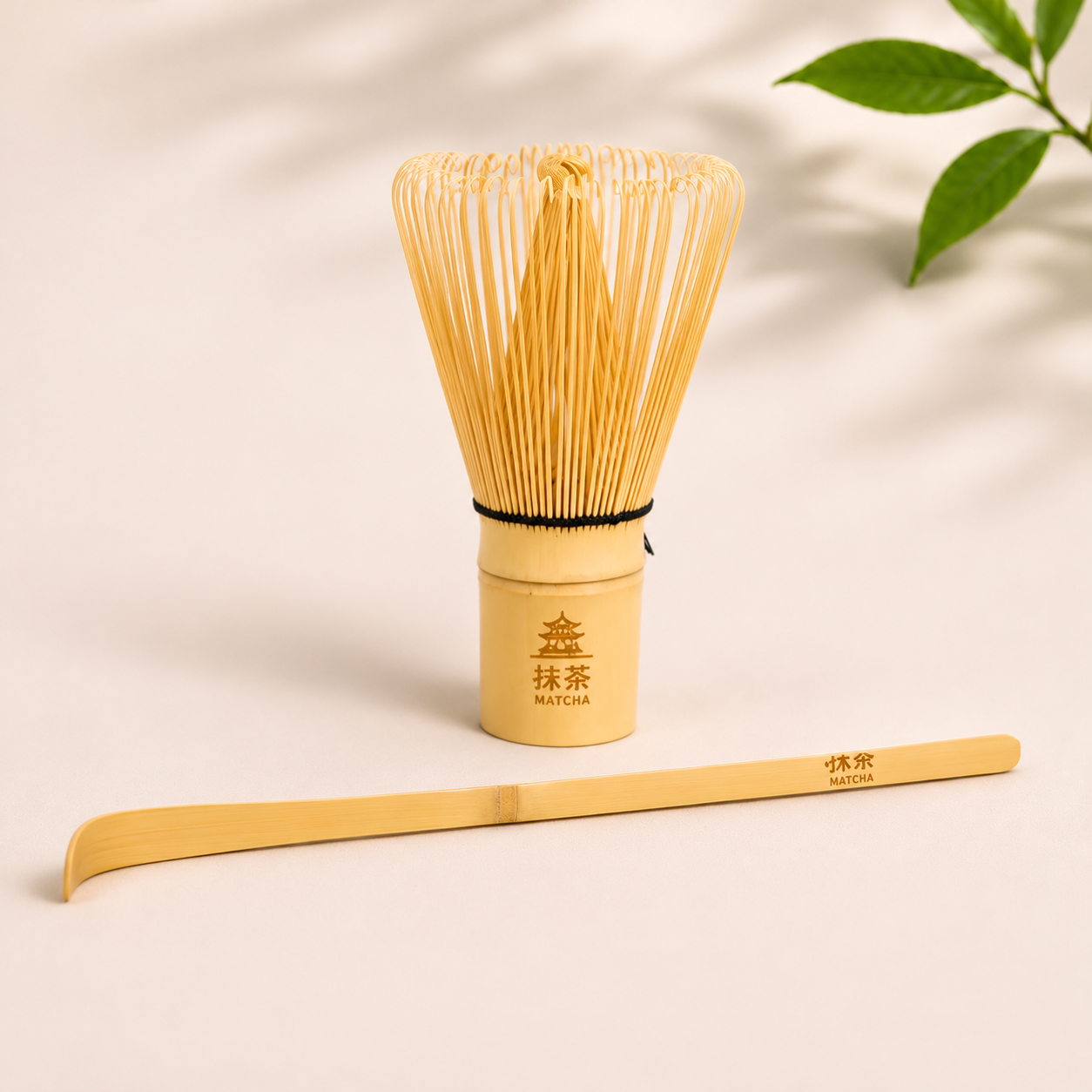
To measure precisely, the scoop and whisk set is very handy: two heaped chashaku scoops are about 2 g, and you can easily drop to 1 g for a lighter afternoon cup. Our guide on how much matcha per day covers sensible amounts.
What to drink in the evening instead
- A caffeine-free infusion: lemon verbena, chamomile, fresh mint on its own (without green tea), orange blossom.
- Warm milk lightly spiced with cinnamon or cardamom.
- Flavoured water with lemon and mint on hot evenings.
Watch out for traditional evening mint tea: it is made with green tea, so it contains caffeine too.
What about late-night studying or work?
Students and people working late are often tempted by a matcha at 9 pm to keep going. The risk is sleeping badly and feeling even more tired the next day. It is better to have your cup earlier and protect your sleep, which matters a lot for concentration. We cover this in our article on matcha for studying.
Insomnia, pregnancy, medication: ask for advice
If you regularly sleep poorly, are pregnant or breastfeeding, or take medication, ask your doctor about your caffeine intake. Matcha is neither a remedy nor a sleep aid, and everyone needs to find their own balance.
In short
- Caffeine per 2 g cup: about 60 to 70 mg.
- How long it lasts: several hours, varying from person to person.
- L-theanine: calmer energy, but the caffeine stays active.
- Suggested cut-off: early afternoon for sensitive people.
- Evenings: caffeine-free infusions or warm milk.
Enjoying your organic matcha powder in the morning and sleeping soundly at night is mostly a matter of timing.
FAQ
Does matcha keep you awake?
It can if you drink it too late, since a 2 g cup contains about 60 to 70 mg of caffeine. Sensitive people are best off having their last matcha in the early afternoon.
Does the L-theanine in matcha help you sleep?
L-theanine combined with caffeine gives a calmer energy, but it does not cancel out the caffeine. Matcha is therefore not a suitable evening drink.
How long do the effects of matcha last?
Caffeine has a half-life of several hours in adults, and it varies a lot between people. Some may still be active at bedtime if you drink matcha in the late afternoon.
What can I drink in the evening instead of matcha?
Choose a caffeine-free infusion such as lemon verbena, chamomile or fresh mint on its own. Traditional mint tea contains green tea, so it also has caffeine.
For this recipe
What we use
Blog
Read next
Matcha and weight loss: what's true and what's exaggerated
Matcha will not make you lose weight on its own. Its real strength is replacing sodas, frappés and very sweet teas with a sugar-free drink. Here are the facts versus the hype.
Drinking matcha on an empty stomach: good or bad idea?
Matcha on an empty stomach suits some people and makes others queasy. It all depends on your stomach: here is how to enjoy it in the morning without discomfort.
Matcha during pregnancy and breastfeeding: caffeine and care
A cup of matcha contains 60 to 70 mg of caffeine. During pregnancy and breastfeeding, the EFSA reference is 200 mg a day from all sources. Here is how to keep track.