
Matcha vs coffee: which one should you choose?
Caffeine, type of energy, stomach comfort, breath and cost per cup: an honest comparison of matcha and coffee, plus an easy plan to switch gradually.
If you want a fast, strong wake-up, coffee is hard to beat; if you want steadier, longer-lasting energy without the afternoon crash, matcha is often the better pick. A cup of matcha (2 g) contains 60 to 70 mg of caffeine, roughly the same as an espresso, but its L-theanine makes the effect calmer. Made at home, it works out at around 3.80 MAD per cup.
How much caffeine is in matcha and coffee?
Matcha contains about 30 mg of caffeine per gram. With the standard 2 g serving, that means 60 to 70 mg per cup: about the same as an espresso, and less than a large filter coffee, which sits around 95 mg. A café crème or a nouss-nouss, the half-coffee, half-milk drink you find in every Moroccan café, is usually in espresso territory since it starts from a single shot.
For healthy adults, EFSA (the European Food Safety Authority) considers up to 400 mg of caffeine a day to be safe, and 200 mg during pregnancy and breastfeeding. Two cups of matcha stay well below that benchmark. For more detail, read our guide on how much matcha per day.
How does the energy feel different?
This is where the two drinks really part ways. Coffee hits fast: within minutes you feel alert, sometimes a little jittery. For many people, the effect then drops off quite sharply, which explains the classic mid-afternoon slump.
Matcha also contains caffeine, but it comes with L-theanine, an amino acid naturally found in tea leaves. L-theanine combined with caffeine gives a calmer, steadier kind of energy: you stay focused without a big spike or crash. That is why so many students and screen workers choose it for long sessions. Everyone reacts differently, of course, so trust how you feel.
Which is gentler on the stomach?
Coffee is an acidic drink, and some people feel heartburn or discomfort when they drink it on an empty stomach. Matcha is generally perceived as gentler, especially when prepared with water at 70–80 °C rather than boiling. It still contains caffeine and tannins, though: if your stomach is sensitive, have it with breakfast or as a latte. If you suffer from reflux or any digestive issue, ask your doctor for advice.
What about coffee breath?
It is a small everyday detail, but it matters: coffee often leaves a strong aftertaste on your breath, not ideal before a meeting or a date. Matcha, with its fresh, grassy taste, is usually much more discreet. It is not a scientific argument, but it is one of the reasons people mention most often after switching.
Which is cheaper per cup?
At the time of writing, our organic matcha powder costs 189 MAD for a 100 g pouch, which makes about 50 cups. That is roughly 3.80 MAD per cup made at home. A café crème or nouss-nouss on a café terrace often costs between 10 and 25 MAD depending on the city and the place, whether you are in Casablanca, Rabat or Marrakech. Home-brewed coffee is still cheap, but matcha compares very well with coffee bought out. To lower the cost per cup even further, the buy 2 pouches, get 1 free offer is the best value. Prices may change, so always check the product page.
How do you switch from coffee to matcha?
In Morocco, coffee is also a social ritual: the morning café crème, the nouss-nouss with friends on a terrace. There is no need to quit overnight. Here is a gradual plan that works well:
- Week 1: replace only your afternoon coffee with matcha, since that is the one most likely to affect your sleep.
- Week 2: switch to a matcha latte in the morning, with hot milk or a plant-based drink; the texture is close to a café crème.
- Week 3: keep a coffee for pleasure on the terrace if you like, and make matcha your work drink.
- After that: adjust to your own rhythm; one or two cups a day are enough for most people.
If you used to drink a lot of coffee, you may feel slightly tired or get a headache during the first days, which is why cutting down gradually is more comfortable. For the method, follow our guide on how to prepare matcha, or start straight away with a homemade matcha latte, the perfect gateway for coffee lovers.
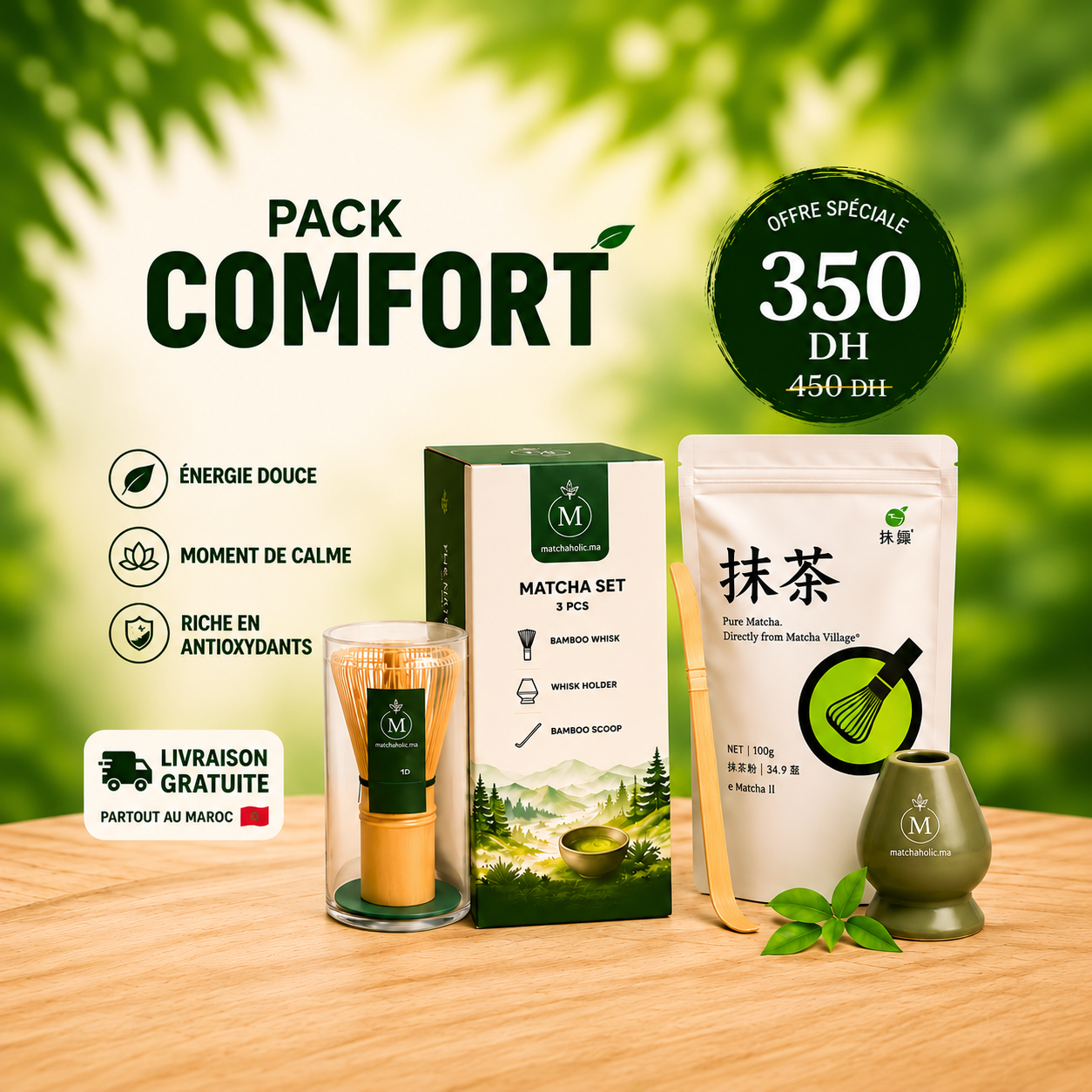
If you are starting from scratch, the Comfort Pack 100 g with kit brings together the matcha and the tools you need. Delivery is free anywhere in Morocco, with cash on delivery.
In short
Matcha first, coffee second:
- Caffeine per cup: 60 to 70 mg / around 60 to 95 mg depending on the brew
- Type of energy: calm and steady / fast and intense
- Afternoon crash: rare / common for some people
- Stomach: generally gentler / more acidic
- Breath: discreet / strong
- Cost per cup: about 3.80 MAD at home / often 10 to 25 MAD at a café
- Best for: long focus sessions / an express wake-up
Matcha or coffee, there is no wrong answer: plenty of people keep both, each at its own moment of the day.
FAQ
Does matcha have more caffeine than coffee?
No. A 2 g cup of matcha contains about 60 to 70 mg of caffeine, roughly like an espresso and less than a large filter coffee at around 95 mg.
Why doesn't matcha cause a crash?
Matcha contains L-theanine, an amino acid found in tea. Combined with caffeine, it gives a calmer, steadier energy with less of a spike and drop than coffee.
Can I drink matcha and coffee on the same day?
Yes, as long as you stay under the benchmark of 400 mg of caffeine a day for a healthy adult. One coffee in the morning and one matcha in the early afternoon stay well below it.
How much does a cup of matcha cost in Morocco?
With a 100 g pouch at 189 MAD at the time of writing, a 2 g cup costs about 3.80 MAD, often less than a coffee at a café.
Is matcha less acidic than coffee?
Matcha is generally perceived as gentler on the stomach than coffee. If your stomach is sensitive, drink it with a meal and ask your doctor if the discomfort continues.
For this recipe
What we use
Blog
Read next
Matcha and weight loss: what's true and what's exaggerated
Matcha will not make you lose weight on its own. Its real strength is replacing sodas, frappés and very sweet teas with a sugar-free drink. Here are the facts versus the hype.
Does matcha keep you awake? Caffeine, timing and tips
A cup of matcha contains 60 to 70 mg of caffeine, which stays active for several hours. Here is when to stop and how to enjoy it without ruining your nights.
Drinking matcha on an empty stomach: good or bad idea?
Matcha on an empty stomach suits some people and makes others queasy. It all depends on your stomach: here is how to enjoy it in the morning without discomfort.